Wednesday, April 7, 2010

Articles Related to Iraq Elections

Articles on Iraq Elections:


Upset Vote Reshapes Iraq

Scramble Is On to Form a Ruling Coalition as Minority Sunnis Take First Place........... more


Allawi Victory in Iraq Sets Up Period of Uncertainty........more


Election Reaction From Around Iraq.........more


Iraq's Kurds Lose Political Dominance In Kirkuk

The results of Iraq's parliamentary elections could complicate Kurdish
hopes of incorporating oil-rich area around the northern city of Kirkuk into their autonomous region. More

After Elections, Iran Remains A Major Player In Iraq

Millions Of Iraqis went to the polls in the country's second national poll, to vote for blocs that were less sectarian than in 2005. The question is whether and how Iraq's fragile, young democracy and national unity can take hold and grow strong enough to resist internal pressure and external interference. More

Iran's Hopes And Fears As Iraqis Prepare To Vote

Success in Iraq's admittedly complicated democratic procedure would establish a model for the Middle East and for Iranians -- a model of a Shi'a-majority government that is broadly secular and moderate. More

Election Campaigning In Iraq, A View From The Ground

As campaigning winds up for Iraq's March 7 parliamentary election, the mood varies widely in different parts of the country. RFE/RL's Radio Free Iraq correspondents in several cities describe how the upcoming election is viewed in their hometowns. More

Election Fever Sweeps Kurdistan

The widespread perception is that in the seven years since the U.S.-led war ousted the Hussein regime, the two principal Kurdish parties have finally succumbed to the myriad problems associated with governance. More

IRAQ ELECTION PROCESS (SUMMARY)

Iraq's general elections, held on March 7, have been heralded as a landmark for the country's emerging democracy, but the system itself is extremely complicated.

According to the electoral law amended in 2009, the seats of the Iraqi parliament have been increased from 275 to 325 seats (In December 2009, after much dispute in parliament, the number of seats was increased to 325 for Iraq's 18 provinces. This translates roughly to 1 seat per 100,000 people.). Around 18.9 million domestic voters and 97,000 expatriates were registered. Female representatives must comprise 25 per cent of the 325 seats in the Iraqi parliament a total of 82 seats.

Elections in Iraq was different from the 2005 elections as 2005 election was based on a closed list system which meant the voter knew the parties included in the list but not the individual candidates. Such a system paved the way for widespread accusations of corruption and fraud with allegations that some parties relied on family ties and allies to allot seats. In the 2010 election the open list system means voters know the names and identities of candidates in the list they are voting for. The open list system allows the voter to express their preference for a candidate within that list. The number of such individual votes will determine which candidates will win a seat. "Open list" system allows for direct representation and greater transparency. The open-list electoral system was first applied during provincial elections in January 2009.

To win a seat in parliament the candidate or list should win the number of valid votes at least equal to the electoral divider. For example, in a governorate of 10 seats and 10,000 valid votes, a candidate or a list must earn 1,000 votes to get a seat. A party would need 163 seats to form a government, but the proportional representation system makes it unlikely that any single party would achieve that figure and a period of coalition building is expected.

Out of the total 325 seats, 310 are distributed over Iraq's 18 governorates, according to each one's population. Eight seats are reserved for minorities and the remaining seven seats are "compensatory seats". Compensatory seats are awarded to winning lists in proportion to the governorate seats they won in the country as a whole. A winning list's compensatory seats are awarded to the candidates who did not win a seat, but who received the list's highest share of individual votes when compared to candidates running for that list in other governorates.

Number of candidates

According to the Iraqi High Electoral Commission (IHEC), 6529 candidates representing 86 political entities put in their bids before nomination closed on December 20, 2009.

Iraqi National Alliance

The coalition is the successor to the United Iraqi Alliance (U.I.A.), the Shiite coalition that dominated the 2005 election but fell apart soon after. It is now the main Shiite opposition to Prime Minister Nuri Kamal al-Maliki, and includes the powerful Islamic Supreme Council of Iraq (I.S.C.I.) and the political followers of the anti-American cleric Moktada al-Sadr, as well as smaller parties. Leading candidates will be a former prime minister, Ibrahim al-Jaafari, and one of Iraq’s two vice presidents, Adel Abdul Mahdi.

This coalition primarily grew out of the United Iraqi Alliance, which held 47 percent of the seats in Parliament in 2005.

KEY LEADERS

Ammar al-Hakim

SHIITEBecame leader of the I.S.C.I. (formerly Sciri), one of the two main Shiite parties, when his father died.

Ibrahim al-Jaafari

SHIITEFormer prime minister. Left Dawa, one of the two most powerful Shiite parties, to form a new party in 2008.

Moktada al-Sadr

SHIITELeads an anti-American group with a strong militia. Loose link to the U.I.A.

State of Law Coalition

Led by Prime Minister Maliki, and dominated by his party, Dawa, which broke off from the U.I.A. Largely Shiite, it also includes 40 smaller parties from across Iraq’s ethnic and religious spectrum. The group did well in last year's provincial elections by focusing on security and the establishment of effective local governments.

Mr. al-Maliki was one of the leaders of the United Iraqi Alliance, which held 47 percent of the seats in Parliament in 2005.

KEY LEADERS

Nuri Kamal al-Maliki

SHIITECurrent prime minister. Left the U.I.A. to recast himself as secular.

Hajim al-Hassani

SUNNIFormer speaker of the National Assembly.

Sheik Ali Hatem al-Suleiman

SUNNIA powerful tribal leader in Anbar Province.

Iraqi Unity

Secular alliance between Shiites and Sunnis, particularly in sprawling Anbar Province. Led by the interior minister, Jawad al-Bolani, a Shiite, and Anbar’s most prominent tribal leader, Sheik Ahmed Abu Risha. Many of its candidates were disqualified because of pasts or sympathies with Saddam Hussein’s Baath Party. The coalition’s members considered joining other larger coalitions, but could not agree on terms.

Some of the leaders from this group were part of the Iraqi Consensus Front, which held 16 percent of the seats in Parliament in 2005.

KEY LEADERS

Jawad al-Bolani

SHIITEInterior minister. Part of a coalition that won no seats in 2005.

Sheik Ahmed Abu Risha

SUNNIA leader of the Awakening movement in Anbar Province.

Sheik Ahmed Abdul Ghafur al-Samaraei

SUNNILeads a party with Shiite and Sunni religious groups.

Iraqiya

A largely secular Sunni and Shiite coalition that has emerged as a potent challenger to the Shiite-led blocs. Led by a former prime minister, Ayad Allawi, a Shiite, and the country’s other vice president, Tariq al-Hashimi, a Sunni. Two of its other leaders, Saleh al-Mutlaq and Dhafir al-Ani, both members of Parliament, were disqualified from running because of alleged sympathies with the Baath Party.

Members of this group came from two coalitions, the Iraqi List and the Iraqi Consensus Front, which together held a quarter of the seats in Parliament in 2005.

KEY LEADERS

Ayad Allawi

SHIITEFormer prime minister with strong links to Western and Arab countries.

Saleh al-Mutlaq

SUNNIFormer candidate, now barred from the election.

Tariq al-Hashimi

SUNNIA current vice president. He ran with the Sunni coalition in 2005.

Iraqi Accord

Also known as Tawafiq, it is made up almost entirely of the Iraqi Islamic Party, whose fortunes have waned in recent years. Many of the more secular Sunni leaders joined other alliances, like Vice President Tariq al-Hashimi, who jumped to Iraqiya. Its most prominent candidate is the speaker of the current Parliament, Ayad al-Samarrai.

This coalition is a remnant of the Iraqi Accord Front, which held 16 percent of the seats in Parliament in 2005, after many of its members joined other coalitions.

KEY LEADERS

Osama Tikriti

SUNNICurrent secretary general and co-leader of the Iraqi Islamic Party.

Ayad al-Samarrai

SUNNICurrent speaker of Parliament.

Kurdistan Alliance

The two dominant Kurdish parties, the Kurdistan Democratic Party (K.D.P.) and the Patriotic Union of Kurdistan (P.U.K.), have formed a formidable alliance, but face an opposition movement called Gorran, or Change. Expected to form a unified Kurdish bloc in Parliament — in keeping with the old Kurdish saying, "We have no friends but the mountains" — and could be a swing vote in determining the next prime minister.

This group has most of the same players as the Kurdistan Alliance, which held 19 percent of the seats in Parliament in 2005.

KEY LEADERS

Massoud Barzani

KURDPresident of the Kurdistan region.

Jalal Talabani

KURDIraq’s president and co-leader of the P.U.K.

Gorran

A new reform group opposed to corruption within Kurdish politics, it is expected to win about 5 percent of the vote. Election experts expect it to join the Kurdistan Alliance after the elections.

KEY LEADERS

Nawshirwan Mustafa

KURDCo-founded the P.U.K., but left in 2009 to create a Gorran.

Saturday, April 3, 2010

summary (Fertile Crescent )From 20th -26th March 2010

Egypt

political front One hundred independent and opposition MPs held a joint press conference in front of the People’s Assembly calling for the discussion of a new law they drafted which lays the foundations for the elections. The draft Political Rights Law was discussed at the event that brought together politicians and political activists. The law lays the foundation of an election process that is full of integrity, freedom and democracy said MP Gamal Zahran.

Egypt’s government is seeking to severely restrict the work of non-governmental organizations, including preventing them from monitoring elections, three dozen NGOs said Monday. Draft legislation to curtail local NGOs will be brought before parliament in the coming months, the groups said in a letter of protest. An official at the government ministry responsible for overseeing the work of NGOs confirmed there was new legislation but refused to discuss its contents because it has yet to be sent to parliament. The 36 groups that protested the draft say it is intended to prevent the monitoring of a parliamentary election to be held by the end of the year and a presidential election next year. In a separate step, 100 opposition lawmakers introduced a bill of their own aimed at allowing free and transparent elections, but this stands virtually no chance of clearing a parliament firmly under the control of President Hosni Mubarak’s ruling party.

Geo strategic front Egypt's foreign ministry summoned Israel's charge d'affaires in protest at its "provocative measures" in occupied East Jerusalem, a day after hundreds of Palestinians clashed with Israeli police. Egypt delivered "a clear message to the effect that Israel must immediately stop all provocative and illegal measures that feed the cycle of conflict," the ministry said in a statement.

Economy

Minister of Finance Youssef Boutros Ghali said Egypt’s budget deficit for fiscal year 2009/10 will come in at 8.5 percent of GDP, predicting that the figure will fall to 7.9 percent for the coming financial year beginning in July. Ghali said the total budget deficit is expected to reach LE 109.2 billion, with revenues at LE 258.4 billion.

MSEs account for 40 percent of total employment. Earlier this month the World Bank announced a $300 million loan to Egypt to finance micro and small enterprises (MSEs). The Enhancing Access to Finance for Micro and Small Enterprises Project is expected to boost job creation and economic growth in the poorest layers of Egyptian society. The loan matures over 28.5 years with a grace period of seven years. “Micro and small businesses are a primary driver for job creation and economic growth in emerging economies,” said Shamshad Akhtar, World Bank vice president for the Middle East and North Africa. “In several countries of this region they contribute to economic diversification and play an important role in private sector development.

Egypt has banned international calls made through mobile Internet connections, one of Egypt's top three mobile phone operators said on Tuesday, which would include internet Skype calls.

Internet telephony firm Skype has questioned Egypt's move to ban international calls made through mobile internet connections and said markets should be left open for consumers to choose. National Telecommunication Regulatory Authority head Amr Badawy told it will ban international calls through mobile internet connections. Skype, which has more than 500 million users worldwide, said in an email statement that it was "seeking clarification" from the regulator about the reported ban. "In general, we believe it should be up to consumers, not regulatory authorities, to choose the winners and losers in the communications space. That is what happens in competitive markets," it said.

Social front The Egyptian Center for Women’s Rights (ECWR) demanded in a statement earlier this month, issued on the sidelines of the favorable Constitutional Court ruling that said women can be appointed to the country’s top advisory court, the immediate issuing of a law to combat discrimination in the country in order to secure “equality, citizenship and efficiency for all Egyptians.” Their calls for a law against discrimination comes only weeks after the controversy over the State Council voted to bar women from standing on the top court. The Constitutional Court, which has a woman sitting on it, said that the vote to ban women was unconstitutional in over turning the earlier decision. The women’s center also expressed “relief and satisfaction” with the Constitutional Court’s ruling and considered it a “tool for establishing justice and law, which ensures women’s equality

Transparency International reported that regulations and poor law enforcement are part of the problems in Egypt toward the fight against corruption, which the organization says is increasing. According to the Berlin-based organization, corruption fighting in Egypt is on the rise. It said that efforts by the government to combat corruption have been curtailed by poor regulations taken and a law enforcement community who continues to take bribes and allow those with money to get off from their crimes.

workers at the influential Muslim website IslamOnline.net said that they would launch an alternative website where they could demonstrate their ability to separate what they call “editorial policies from money”. Prolonged strike continues: Employees at the IslamOnline website protesting at their 6th of October City premises of the website, west of Cairo. They have been on strike for 11 days now.

Iraq

Political front

Elections

One hundred independent and opposition MPs held a joint press conference in front of the People’s Assembly calling for the discussion of a new law they drafted which lays the foundations for the elections. The draft Political Rights Law was discussed at the event that brought together politicians and political activists. “The law lays the foundation of an election process that is full of integrity, freedom and democracy,” said MP Gamal Zahran, spokesperson of the independent bloc at the PA. The MPs called on Parliament Speaker Ahmed Fathi Sorour to discuss the draft law at the PA so that it could be passed before the end of the final session of the current PA, which concludes this year.

With nearly 80 percent of the votes counted from Iraq's March 7 parliamentary elections, the main winners appear to be Prime Minister Nuri al-Maliki and challenger Iyad Allawi. But the two front-runners are neck and neck. The vote count so far shows Allawi's Al-Iraqiyah coalition narrowly ahead of Maliki's State of Law alliance by less than 9,000 votes.

Iran has congratulated Iraqis over an election that is likely to keep a bloc led by its Shi'ite ally, Prime Minister Nuri al-Maliki, in power after a campaign in which Tehran's influence was a divisive issue. Maliki's main challenger, former Prime Minister Iyad Allawi, who headed a secular list mixing Shi'ite and Sunni Arabs, made a high-profile visit to Saudi Arabia during the campaign to improve ties with Iran's biggest Sunni rival in the Persian Gulf region. "All international supervision has confirmed the soundness of the Iraqi elections. This is a success and we congratulate Iraqis," Iranian Foreign Ministry spokesman Ramin Mehmanparast said at a weekly press briefing on English-language state television.

Iraqi President Jalal Talabani has issued a statement urging a recount in some areas of votes from the country's March 7 parliamentary elections. The request suggested that ballots be counted anew "to ensure justice and absolute transparency." But Iraq's Independent High Election Commission rejected the idea, saying final results would be issued on March 26.

Geo strategic front

Lebanon's ambassador to Egypt will attend the Arab summit in Libya after President Michel Sleiman decided not to go amid a spat over the suspected disappearance there of a prominent Lebanese cleric, the government said. The cabinet "unanimously agreed that Khaled Ziyadeh, Lebanon's ambassador to Cairo and representative to the Arab League, will represent Lebanon at the Arab summit" on Saturday and Sunday, Information Minister Tarek Mitri told reporters.

Economy Iraq has agreed with Turkey to renew an accord to operate an oil pipeline from its northern oil fields near Kirkuk to the Turkish Mediterranean port of Ceyhan, a senior Iraqi oil official has said. "Iraq has approved to renew the Kirkuk-Ceyhan agreement after agreeing on some changes and amendments", Iraq's deputy oil minister, Ahmad al-Shamma, told Reuters. Shamma said the two sides had agreed on new transit fees and upgrades to the pipeline.

U.S. Secretary of State Hillary Clinton and Secretary of Defense Robert Gates have requested an extra $37.5 billion from Congress to fund military and civilian operations in Afghanistan, Pakistan, and Iraq. The Pentagon is seeking $33 billion of the request, and most of the total amount would go toward funding operations

Social Iraqi women demonstrators protest lack of security and basic services [EPA]

Prior to the US-led invasion of Iraq, women working in the public and government sectors were entitled to receive a year's maternity leave under family laws enforced by the former Saddam Hussein leadership. In the seven years since the US-led invasion which ousted Saddam, however, maternity leave has been cut to six months. Since the Personal Status Law was enacted on July 14, 1958, when Iraqis overthrew the British-installed monarchy, Iraqi women have enjoyed many of the rights that Western women do.

Lebanon

Tawheed Movement head former minister Wi’am Wahhab reiterated Saturday calls for Lebanese President Michel Sleiman to resign. “The late Egyptian President Jamal Abdel-Nasser resigned, so why doesn’t Sleiman?” asked Wahhab, who is a close ally of Syria. “Where is the problem if he wasn’t able to fulfill his promises of eradicating corruption and guaranteeing transparent administrative appointments?” Wahhab’s Saturday comments sparked a new wave of criticism from politicians of the parliamentary majority.

Lebanon and Jordan signed 16 agreements, protocols and memoranda of understanding in Beirut on Friday, Lebanese PM office announced. The agreements include cooperation between the Jordanian Institute for the Development of Economic Projects and the Lebanese Trade Information Center for the years 2010-2011, a technical program to activate the mutual recognition agreement on conformity certificates and quality marks, and administrative cooperation agreement on customs procedures. They also include cooperation on animal health and production, cooperation in the agricultural sector, and the executive program for tourism cooperation for the years 2010-2012

Barclays Capital projected economic growth in Lebanon at 6 percent in 2010, down from 8 percent in 2009, adding that initial indicators point toward sustained growth this year but at a slower pace than last year, as reported by Lebanon This Week, the economic publication of the Byblos Bank Group. It expected private consumption to slow down but to be offset by a pick-up in private and public investment, and by continued strength in services exports in line with gradual recovery in the GCC.

The UN’s Electronic Participation Index for 2010 ranked Lebanon in 45th place among 179 countries worldwide and 6th among 19 countries in the Middle East and North Africa region, as reported by Lebanon This Week, the economic publication of the Byblos Bank Group. Lebanon came in 28th place globally and in second place regionally in the previous 2008 survey. Also, Lebanon ranked 8th among 36 upper-middle income countries (UMICs) included in the 2010 survey and 5th in the previous survey. The index is an assessment of 21 public informative and participatory services and facilities in e-information, e-consultation and e-decision making across 6 general, economic and social sectors such as education, health, social welfare, finance and employment.

Tourism Minister said that the tourism activity in Lebanon would improve by 10 to 20 percent in 2010 and assured that there would not be an Israeli war on Lebanon. “During the past two months, the number of tourists increased by 22 percent which is a very good indicator and we expect this number to exceed 2 million in 2010,” he said.

summary (Fertile Crescent )From 7th -13th March 2010

Egypt

Political front:

Several Egyptian opposition groups called for political reforms and more freedoms in a statement on Monday at the end of a three-day conference, the official news agency MENA reported. The groups, which include established opposition parties such as the leftist Tagammu and the liberal Al-Wafd, demanded an end to the concentration of power in the president's hands and reforms to laws that place restrictions on parties. They also called for peaceful protests ahead of parliamentary polls due in October.

The National Democratic Party (NDP) has denied accusations of a secret deal struck with certain opposition parties to divide the Muslim Brotherhood’s current parliamentary seats amongst them and to ignore the presidential ambitions of former IAEA chief Mohamed ElBaradei. Al-Shorouk newspaper quoted an unnamed senior NDP source as refuting claims that a deal had been struck with Al-Wafd party to coordinate efforts during the parliamentary elections set for October, saying the NDP “does not fear anyone and does not make deals for individuals.”

Geo strategic front:

EU foreign policy chief Catherine Ashton said that Israel's decision to build new settler homes in east Jerusalem "endangers" indirect talks between Israel and the Palestinians. "Recent Israeli decisions to build new housing units in east Jerusalem have endangered and undermined the tentative agreement to begin proximity talks," she said in Cairo where she addressed members of the Arab League. "The EU position on settlements is clear. Settlements are illegal, constitute an obstacle to peace and threaten to make a two state-solution impossible," Ashton said.

Arabs across the Middle East are unconvinced the United States will stand up to Israel despite Washington's rare public outrage over plans to build new Jewish homes in a traditionally Arab part of Jerusalem. The skepticism is eroding Arab hopes that President Barack Obama will push hard for a long-sought peace deal between Israel and the Palestinians to end a conflict that has fueled anti-US sentiment in the region. America's dwindling credibility could also jeopardize another major Mideast goal — uniting the Arab world against Iran. Paul Salem, director of theCarnegie Middle East Center in Beirut, said Arab countries will be less likely to engage with theUS on issues such as Iran if they get nothing in return.

Economic front:

Private equity firms in the Middle East are looking at development financial institutions (DFIs) as an alternative to elusive bank lending, executives said. “The change in mix of funding providers — more (reliant) on development financial institutions as opposed to Western commercial banks — is going to be the theme for private equity in 2010,” said Ahmed El Houssieny, managing director at Cairo-based Citadel Capital, at a conference in Dubai.

With the advent of the global financial crisis, most countries saw their construction activities grind to a halt as banks tightened lending. In this respect, Egypt is proving resilient; indeed, its cement producers are trying to keep pace with an energetic construction industry. As an anti-crisis measure, the government has aimed stimulus money at large infrastructure development projects, including water treatment plants, railways, highways and housing. Around LE 23 billion (€3.1 billion) has been issued since October 2008 to stimulate the economy, and the People’s Assembly is currently pushing through another LE 10 billion (€1.35 billion) in stimulus cash, which will be financed by the sale of land plots. This construction surge should help push the GDP growth rate above 5 percent in the 2009/10 fiscal year, after registering 4.7 percent in 2008/09.

Social front

Egyptian President Hosni Mubarak appointed a new head of Al-Azhar, Sunni Islam's most prestigious institution, after the death of its top cleric last week, the official MENA agency reported. Mubarak, who is recovering from surgery in Germany, "has issued a presidential decree appointing Sheikh Ahmed Mohammed Ahmed Al-Tayeb to head Al-Azhar," MENA reported.

International donors are to gather in Egypt's capital with a $2 billion target for the reconstruction of Darfur, Sudan's western region devastated by a seven-year war. The one-day conference has been organized by the Organization of the Islamic Conference (OIC), which groups 57 members to form the world's largest Islamic assembly, and is to be co-chaired by hostEgypt and Turkey. Around 25 non-OIC member states and 50 international organizations and NGOs have also been invited to take part. The $2 billion which the conference aims to raise is to finance in cooperation with Khartoum a long list of development projects in agriculture, water supply, health and education. "The conference aims to send a clear message to the international community that development is a key factor in achieving peace and stability in Darfur," the host nation said in a statement. Aid to Darfur has so far concentrated on humanitarian and relief efforts. But organizers are trying to shift gear by working on a more long-term vision for Darfurthrough development and reconstruction projects.

Employees of the Islam Online (IOL) website continued their sit-in for the third day running at their Sixth of October offices, demanding their settlement packages after the majority of them submitted their resignation. A source from IOL who spoke on condition of anonymity said, “Qatar has reneged on the deal for the severance packages. A lawyer is currently present to discuss legal rights.” IOL employees started a strike after warnings of mass layoffs and employee investigations by the funder of the site, Qatar’s Al-Balagh Foundation. It was also announced that their contracts, which expire at the end of March, would not be renewed. A total of 300 employees submitted their resignations Tuesday after being told it was the only way to ensure they receive severance packages.

Egypt was listed as an “enemy of the internet” by Reporters Without Borders as a US State Department 2009 report on human rights highlighted Egypt’s ill-treatment of bloggers and internet activists in 2009. The internet has become a “battlefield for supporters and opponents of fundamental human rights,” the US State Department report said.

The majority of Islam Online (IOL) Egypt’s 330 staff submitted their resignation following a two-day sit-in spurred by warnings of mass lay-offs and employee investigations by the website’s Qatari owner.

The dispute between the Egyptian office of Islam Online (IOL) and the board of its funding foundation in Qatar continued even after two members of the board were suspended and a general meeting was called for to resolve the issue. Though it seemed that it was the end of the line for the 330 employees of IOL in Egypt, matters took a turn Wednesday night when the board of the Qatari Al Balagh Foundation, headed by Sheikh Yousef El-Qaradawi, voted to suspend the membership of two members who were allegedly behind the plans to relocate the office to Qatar.

Iraq

Political front: Elections

A list led by Shi'ite Prime Minister Nuri al-Maliki had a wide lead in early results from the southern oil hub of Basra a week after Iraq's parliamentary election, the country's electoral commission said on March 14.

With nearly 80 percent of the votes counted from Iraq's March 7 parliamentary elections, the main winners appear to be Prime Minister Nuri al-Maliki and challenger Iyad Allawi. But the two front-runners are neck and neck. The vote count so far shows Allawi's Al-Iraqiyah coalition narrowly ahead of Maliki's State of Law alliance by less than 9,000 votes. The Iraqi National Alliance, a coalition of Shi'ite religious groups, looks set to come in third, followed by the Kurdistan Alliance, composed of the two main factions in the autonomous Kurdish region. With 20 percent of the vote remaining to be counted, the balance between the two front-runners still could easily tip either way. Coalition Talk But what appears almost certain is that neither will be able to amass enough seats in parliament to rule alone. Already in Baghdad the talk is all about coalition building, and which party will partner with others. One senior candidate with the Al-Iraqiyah list, Intisar Allawi, a relative of Allawi, said on March 16 that the group held "very good and positive talks" with the Iraqi National Alliance and with the Kurdistan Alliance. At the same time, Prime Minister Maliki has invited all parties in Iraq to join negotiations with his State of Law alliance.

Iran has congratulated Iraqis over an election that is likely to keep a bloc led by its Shi'ite ally, Prime Minister Nuri al-Maliki, in power after a campaign in which Tehran's influence was a divisive issue. Maliki's main challenger, former Prime Minister Iyad Allawi, who headed a secular list mixing Shi'ite and Sunni Arabs, made a high-profile visit to Saudi Arabia during the campaign to improve ties with Iran's biggest Sunni rival in the Persian Gulf region. "All international supervision has confirmed the soundness of the Iraqi elections. This is a success and we congratulate Iraqis," Iranian Foreign Ministry spokesman Ramin Mehmanparast said at a weekly press briefing on English-language state television. "We hope we'll be able to see the formation of the new government as soon as possible...the whole region will benefit from security in Iraq." Early results from the March 7 parliamentary vote show Maliki's State of Law bloc ahead in seven of 18 provinces, while strong Sunni Arab support has propelled Allawi's secularist Al-Iraqiyah list into second.

The results from the general elections indicate that the sectarian equation brought about in the aftermath of the occupation of Baghdad may no longer hold. We have seen Iraqis rallying behind groups which puts national interests above sectarianism. Some even go on saying that the equation has lost its balance. The evidence they cite are the results in provinces such as Nineveh, Salahuddeen, Anbar and Diyala where the electorate chose a secular coalition at the expense of an Islamist party. On the other hand, there are many who say that some other political blocs have preserved their standing by relying on sectarian support. These people add that the coalition of the State of the Law headed by outgoing Prime Minister Noor al-Maliki and the National Coalition are none but sectarian formations. This is evident in the overwhelming support they obtained in certain provinces. In the meantime, even those entertaining hopes for the emergence of a secular state, have their doubts.

Partial results from the Iraqi parliamentary election indicate that Prime Minister Nouri al-Maliki’s ruling State of Law bloc is leading in Baghdad and the provinces to the south. The big surprise has been the victories of al-Maliki’s main rival, former Prime Minister Iyad Allawi, whose al-Iraqiya list seems to be sweeping the Sunni regions along Baghdad’s northern rim. The rise of al-Iraqiya, along with the fact that al-Maliki hasn’t completely dominated the Shiite south, suggests that he will have a hard time cobbling together a coalition government that is Shiite-dominated and has a reasonable degree of Sunni representation.

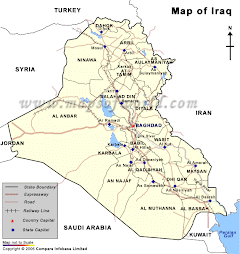
Regardless of whether it is Nuri al Maliki’s or Iyad Allawi’s bloc that will emerge victorious in the Iraqi elections, initial indications up until the publication of this article show that Allawi has won Arab Sunni governorates and al Maliki has won Arab Shia governorates. In geographical terms, Allawi has won western Iraq and some of its northern parts, whereas al Maliki has won southernIraq and most of the central areas of the country. So the fight for Baghdad, the jewel of the Iraqi crown, continues. Either al Maliki or Allawi will win the majority of votes but whoever wins would have done so by the skin of his teeth. What’s striking is that in the electoral programs of competing lists they all praise national unity and reject sectarianism.

The Governor of the Province of Nineveh has asked the United Nations and the European Union to undertake an international investigation into attacks targeting Iraqi minorities in his province. Atheel al-Nujaifi said violence against minorities in Nineveh, of which the northern city of Mosulis the capital, has surged recently. He said Christians were being forced to flee and some of them have been killed. Other minorities like the Shebek and Yazidis are under immense pressure and targets of mounting violence, he said.

Social front

The U.S. State Department's annual human rights report says more than 30 wars and armed conflicts around the world are fueling human rights abuses, including what it calls "an alarming number of reports of torture, extrajudicial killings, and other violations of universal human rights."The annual report, which is mandated by U.S. Congress, is actually 194 individual country reports on human rights practices, which are researched and written to provide what the State Department says is "the most comprehensive record available of the condition of human rights around the world." The reports criticize or praise the human rights records of U.S.friends and foes alike.

Lebanon

Political front

Protecting Lebanon was the focus of the March 14 alliance meeting at the Bristol Hotel on Sunday. March 14 General Secretariat Coordinator Fares Soueid briefed the press after the gathering, which he said was aimed at guaranteeing the well-being of all Lebanese, despite their political and sectarian differences. “Protecting Lebanon is a national, Arab and international responsibility,” he said. Regionally, Lebanon is threatened by Israel, according to Soueid. It refuses to work towards peace and continues to build settlements, he added. He also cited Iran’s nuclear program as a danger to the country and region. “We want to see the country united and free, fully Lebanese and fully Arab,” Soueid added. Despite any mistakes that were made, the Cedar Revolution will continue until its goals are achieved, the March 14 General Secretariat coordinator said. With that, Soueid introduced a seven-point plan to “preserve the safety of the Lebanese people,” and called on the Lebanese to develop and elaborate on it.

Syrian President Bashar al-Assad is ready to to turn a page on the past by meeting Lebanon's Druze leader Walid Jumblatt, Hezbollah, which is mediating between the former arch-foes, said on Monday. The Lebanese Shiite group's leader Hassan Nasrallah "has advised Jumblatt that given recent developments, the Syrian authorities will forget the past and open a new page," it said in a statement. "President Assad will receive him in Damascus during a visit on a date to be announced in the coming days," Hezbollah added. The announcement came two days after the Druze leader admitted he had made "inappropriate and unreasonable remarks about President Assad at a time of internal tensions and extreme division within Lebanon.

Economic front

Lebanon is yet to receive an official invite to the Arab Summit that will be held in Libya at the end of this month. It has been confirmed that Lebanese President Michel Sleiman will not attend the summit. The Lebanese President previously told Asharq Al-Awsat that this subject is “problematic” and denied the option of taking part.